Every move is surveyed before it is booked.
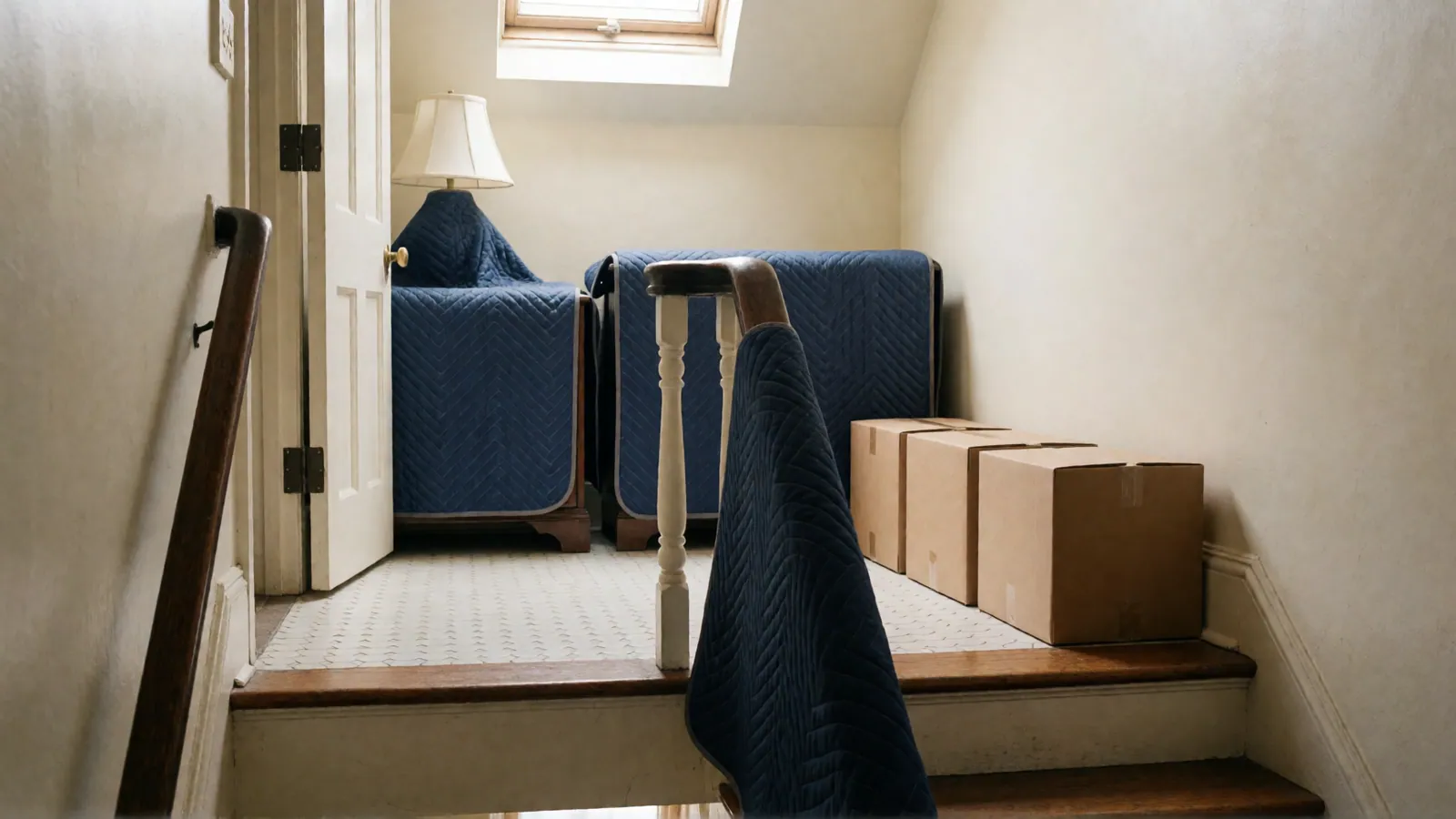
The top-floor landing of a walk-up under a skylight: two dressers and a lamp wrapped in quilted navy moving blankets and three plain kraft boxes waiting beside an open apartment door, a blanket over the post of the stair rail.

Moves

Third floor, no elevator, a turn on the landing

Elevator buildings and walk-ups alike: the stairs walked first, the banister wrapped, and an extra mover from the fourth floor up.

  • $150 to $260 an hour, no sales tax
  • No fee per flight
  • One more mover from the fourth floor up

AI-generated illustration. Not a real home or business.

The stairs are walked before anything is carried

On a walk-up the building sets the pace, not the furniture. Before the first piece comes down, the crew lead walks the stairs from your door to the street: how tight the turn is at each landing, where the banister pinches the stair, how low the ceiling comes over the turn, which way the street door swings, and whether a light is out on the way.

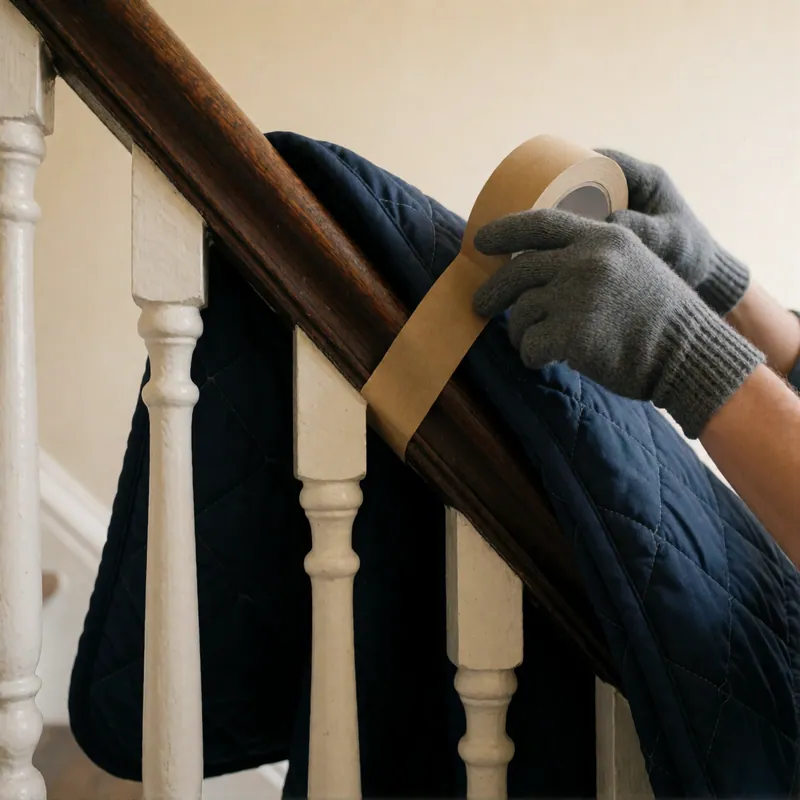
The banister is wrapped because it is the first thing a sofa's corner finds on a turn, and an old newel post is a repair for your landlord, not a scuff. Runners go down in the hall and on the landings, and pads go on every door frame between the apartment and the street, before a single box is lifted.

  • No fee per flight: stairs take time, and the time is billed.
  • From the fourth floor up, the crew grows by one.
A mover's hands in gray knit gloves, the forearms bare, taping a quilted navy moving blanket over the dark wooden handrail of a stairwell with tan tape, white-painted turned balusters below.AI-generated illustration. Not a real person, home or business.

Why the crew grows by one, high up

The move planner asks how each end of the move is reached, in the building's own terms. These are its seven answers:

  • Street level, or a short stoop
  • An elevator building
  • A house with stairs inside
  • A walk-up, second floor
  • A walk-up, third floor
  • A walk-up, fourth floor
  • A walk-up, fifth floor or higher

Every flight adds time to every trip, down and back up, and time is what a move is charged by, so the stairs are in the hours and nowhere else.

From the fourth floor up, the planner adds a mover to the crew, up to a crew of four. On a high walk-up, movers who each carry a piece all the way down and climb all the way back up empty-handed spend most of the day climbing. One more mover turns the stairs into a chain: one carries down to a landing, one carries on from the landing to the street, one loads, and nobody climbs the whole building with empty hands.

A bigger crew costs more an hour and takes fewer hours on the same stairs. The rates page shows each crew's rate; the planner shows the hours.

Time, not fees. There is no fee per flight of stairs, no fee for a long walk to the truck, no fuel surcharge and no charge for tolls on a route we choose. Stairs and a long walk take time, and the time is what you pay for; the move planner adds it to the hours.

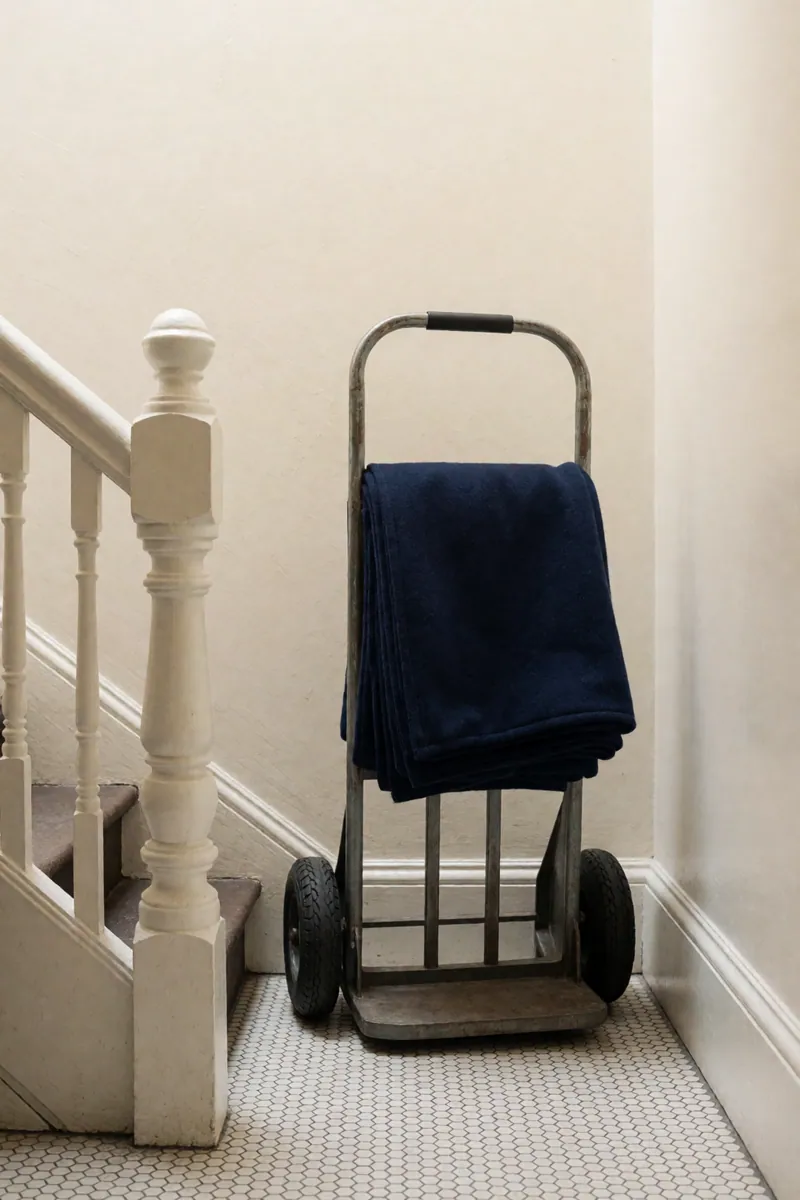
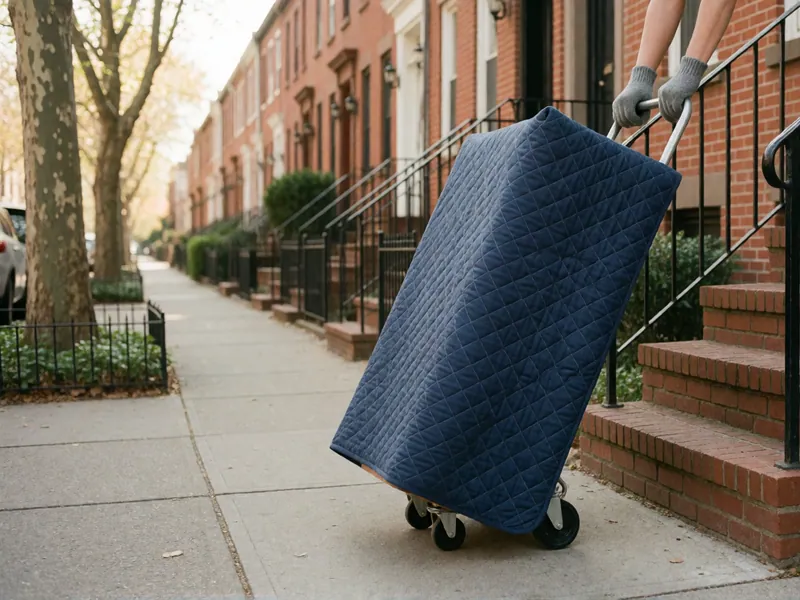
A steel two-wheel dolly with a folded navy blanket over it, standing on a white hexagon-tile landing beside the white-painted newel post and balusters of a walk-up staircase.AI-generated illustration. Not a real home or business.

Bartholomew Nwosu-Strand

Crew lead

Leads the walk-up crews in Astoria, Sunnyside and Ridgewood.

Bartholomew walks the stairs once before the first piece comes down.

Bartholomew wraps the banister before he wraps the furniture.

The picture is a still of the work, not a portrait.
The sofa and the turn on the landing

A sofa that came up the stairs will usually go down them, though not always the way it came. The legs come off first. On a tight turn it travels on its end, walked round the landing upright and tipped onto the next flight; a door may come off its hinges to give a frame the room it needs.

What decides it is measured, not guessed. Before the survey, measure the widest sofa and the tallest wardrobe, and the narrowest door either must pass; on the survey, show us the stairs from the street. A piece that cannot make the turn is found then, not on the landing with the crew holding it.

And when a piece really will not go, the answer is never the window.

When a piece fits neither the stairs nor the elevator, lifting it outside the building is rigging, and in New York City that is done by or under a licensed rigger. We don't do it. We tell you before moving day, you hire the rigger, and we carry the piece from the curb.

Elevator buildings

An elevator building trades the stairs for the wait.

A crew that shares a passenger elevator with the residents waits at every trip, and the waits add up across a day. A reserved service elevator, padded, with its door held, is a different move altogether: the crew loads it, rides with it and unloads it, trip after trip, with nobody else's groceries in it.

The walk counts as well. A long hall from the apartment to the elevator, and a lobby from the elevator to the curb, are part of the carry, and the planner asks how far the truck can stop from the door for the same reason.

Reserve the service elevator for the move, and ask whether it has to be padded and when the building's moving hours end. A reserved elevator is often what keeps an apartment move inside its range.

Many co-ops, condos and managed buildings ask a mover for a certificate of insurance before the crew may use the service elevator, naming the building as the holder. A real mover's insurer issues it; ask the managing agent exactly what it must say, and ask a week or more ahead. It is the building's rule, not a law. This demonstration company holds no insurance, so it has no certificate to send.

A worked example: a third-floor walk-up

The same arithmetic as the planner, at the published rates. The household is invented.

A worked example: a planning range

One bedroom, third-floor walk-up to an elevator From Astoria to Woodside

One bedroom, about average · start: a third-floor walk-up · end: an elevator building · the kitchen and the breakables packed by us · a few pieces taken apart

  • Crewfor this home and these stairsTwo movers
  • Trucknamed by its length16-foot box truck
  • Hours on the jobbilled in quarter hours5¼ to 7¾ hours
  • Travel time, both waysone allowance each waythirty minutes
  • Hourly rateevery day a move runs$150 an hour
  • The time, at the ratethe hours and the travel; no sales tax$862.50 to $1,237.50
  • Putting furniture back togetherits own line, at the same rate$112.50 to $150.00
  • Sales tax on that line8.875%, New York City$9.98 to $13.31
  • Boxes, counted on the daynot in the range: charged by the box25 to 40 boxes
  • The rangea planning range, not an estimate$984.98 to $1,400.81

The move planner's answer to these questions, at the published rates. A planning range is not an estimate or a quote.

Plan your own apartment move

Related services

Plan your move

Try the move planner: a crew, a truck and a range of hours at the published rate, in about two minutes. Sending it to us books nothing.