The journal
Packing a kitchen the way packers do
Plates on edge, glasses in cells, the heavy things low and the box never too heavy to lift, and the box that travels with you, not on the truck.
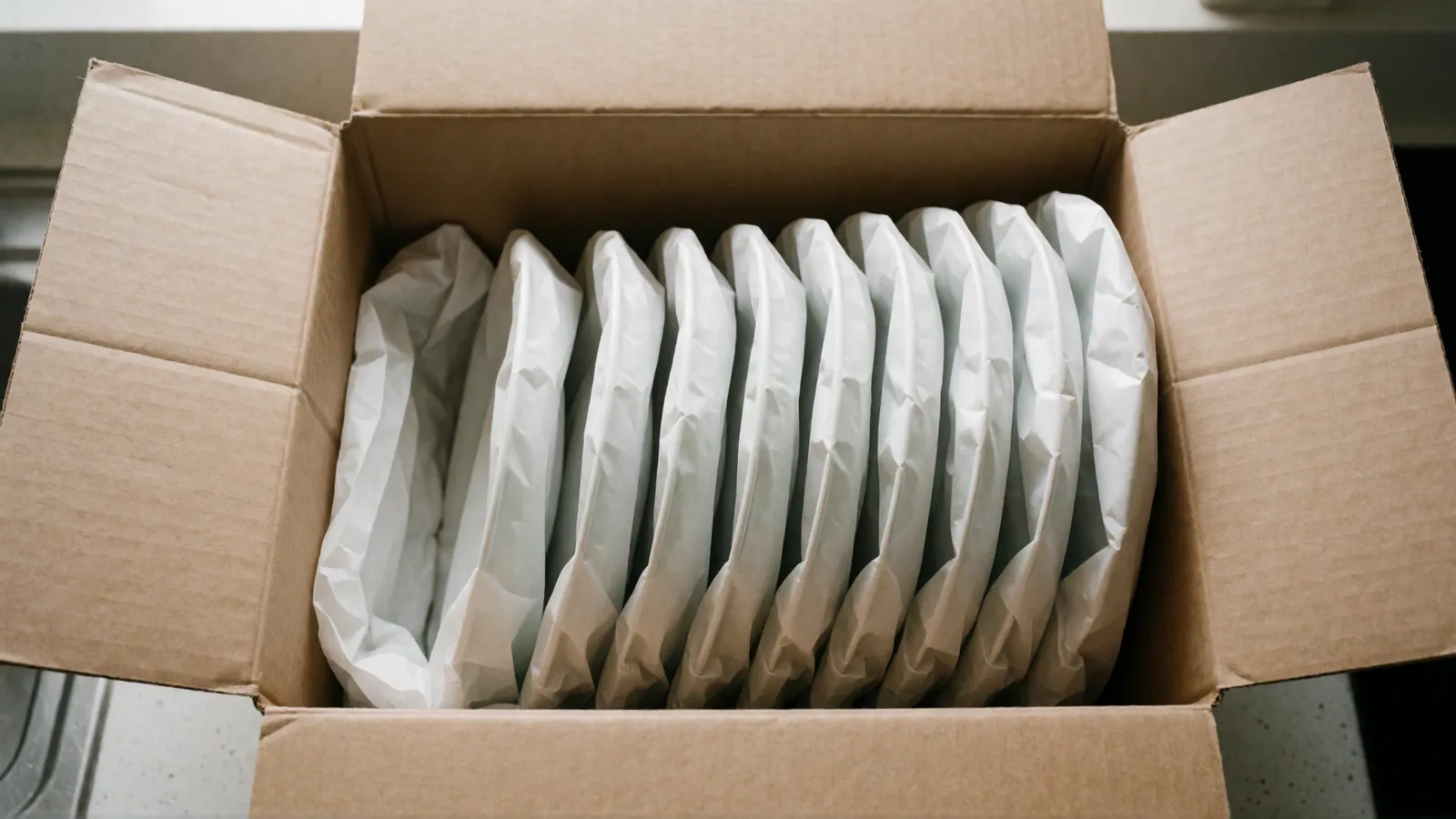
AI-generated illustration. Not a real home or business.
A kitchen takes longer to pack than any other room, holds more that can break than any other room, and is almost always packed last, the night before, by someone who is tired. Packed the way packers do it, it is slower box by box and shorter overall, because nothing has to be unwrapped and wrapped again at midnight, and far less of it arrives in pieces.
Start with what you don't use
Begin a week or two out with the things that come out once a year: the roasting pan, the good glasses, the platter, the cake tins, the cookbooks. Cookbooks go in small boxes, like any other books. Leave a few days of everyday plates, a pan, a pot and the coffee things until the end, and pack those last.
Go through the cabinets as you pack. Every chipped mug and odd lid that goes in a box is wrapped, carried, unwrapped and put away at the other end, and a move charged by the hour pays for each of those steps.
Plates on edge, in a dish pack
A dish pack, a double-walled box for plates and glasses, is the box for this. Its double walls take the knocks a single wall passes straight through to the plates inside.
Crumple a layer of paper into the bottom. Wrap each plate on its own in plain packing paper (newspaper ink comes off on china) and stand them on edge in a row, the way records stand in a crate. Yesenia Dorsey-Albescu leads the packers, and packs every kitchen herself. She wraps each plate on its own and stands it on edge in the dish pack.
On edge is the whole trick. A plate standing up takes a bump across its rim, which is its strongest way; a stack of plates lying flat takes every pothole on the bottom plate, and the bottom plate cracks first. Bowls go the same way, wrapped and on edge, or nested in pairs with paper between them. Fill every gap with more paper. A dish pack that rattles when it is lifted will break something before it is unloaded.
Glasses on top
Glasses and stemware go in the top layer, with a sheet of folded paper or a flat piece of cardboard between them and the plates, and nothing goes on top of them. Wrap a stem glass stem first, then the bowl, and stand it upright. Cardboard dividers help if you have them; without them, wrap each glass twice and pack them close enough that none can tip.
Heavy things low, and never too heavy to lift
Pots and pans nest inside each other at the bottom of a medium box, with paper between them, and the lids wrapped separately down the side. Small appliances go in their own boxes if you kept them, or wrapped in a towel. Knives are sheathed, or rolled in a dish towel and taped, and the box is marked so the person who opens it knows. Cans and jars from the pantry go in a small box (book box), because a large box of them is too heavy to carry safely.
Oils, vinegars and sauces travel upright in a sealed plastic bag inside the box, so one loose cap doesn't soak the rest. Paper goes a long way in a kitchen, and more of it is used than anyone expects; the price list sells it as plain packing paper, a 10-pound bundle.
What stays behind
The cabinet under the sink and the refrigerator are where the kitchen's exceptions are. Paint, propane, gasoline, oil, cleaning chemicals and anything else that can burn or leak stay off the truck, and so do perishable food and plants. Eat the freezer down in the last week, give away what is left, and empty the refrigerator the day before so it can be wiped out and left open to dry.
Keep cash, jewelry, papers, medicine and your keys in a bag that travels with you. Then pack one box for the first night and the first morning: the kettle or the coffee maker, a few mugs and plates, a pan, a knife, dish soap and a towel, and mark it on every side. Put it in your own car, or last onto the truck so it comes off first.
If we pack it
Packing is charged by the hour at the same rate as the move, and the boxes our packers use are charged per box at the price list. A studio or one bedroom is usually packed on the morning of the move; a bigger home is often packed the day before, by the same crew.
Here is one of the planner's worked examples with the kitchen and the breakables packed by us and the rest packed by the household:
A worked example: a planning range
One bedroom, third-floor walk-up to an elevator From Astoria to Woodside
One bedroom, about average · start: a third-floor walk-up · end: an elevator building · the kitchen and the breakables packed by us · a few pieces taken apart
- Crewfor this home and these stairsTwo movers
- Trucknamed by its length16-foot box truck
- Hours on the jobbilled in quarter hours5¼ to 7¾ hours
- Travel time, both waysone allowance each waythirty minutes
- Hourly rateevery day a move runs$150 an hour
- The time, at the ratethe hours and the travel; no sales tax$862.50 to $1,237.50
- Putting furniture back togetherits own line, at the same rate$112.50 to $150.00
- Sales tax on that line8.875%, New York City$9.98 to $13.31
- Boxes, counted on the daynot in the range: charged by the box25 to 40 boxes
- The rangea planning range, not an estimate$984.98 to $1,400.81
The move planner's answer to these questions, at the published rates. A planning range is not an estimate or a quote.
Plan your move
Try the move planner: a crew, a truck and a range of hours at the published rate, in about two minutes. Sending it to us books nothing.