Before the move
The week before the truck comes
The buildings, the street and the boxes: the three things that decide how long a move takes, all settled before the crew knocks.
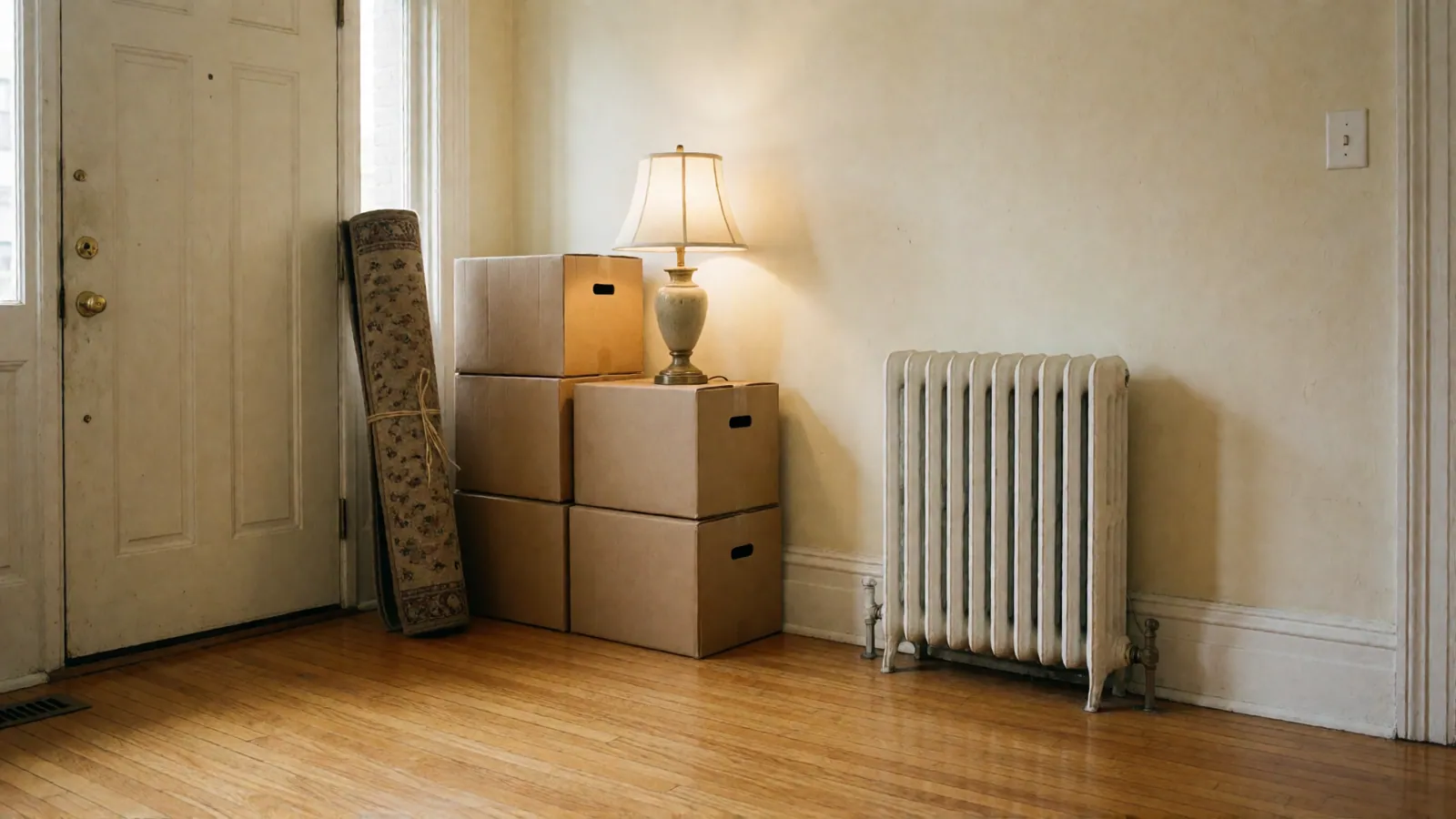
AI-generated illustration. Not a real home or business.
In the week before the move
In the order they are worth doing.
Ask both buildings what they need from a mover, and when their moving hours are.
Reserve the service elevator at both ends, and ask whether it has to be padded.
Pack and close every box, unless our packers are doing it, and write the room on two sides.
Empty the drawers of anything that can spill, break or that you'd carry yourself.
Take down the curtains and the television from the wall, and unplug what can be unplugged.
Keep cash, jewelry, papers, medicine and your keys in a bag that travels with you.
The buildings come first because everything else hangs on them: the move has to fall inside both buildings' moving hours, and the certificate and the elevator are arranged for that date.
The boxes come next, because a kitchen still on its shelves when the truck arrives is the slowest room in any move. A box closed, taped and labeled the night before is carried and stacked without a pause; a box still being packed holds up everything behind it.
 AI-generated illustration. Not a real home or business.
The buildings
Both of them: the one you leave and the one you move into.
Many co-ops, condos and managed buildings ask a mover for a certificate of insurance before the crew may use the service elevator, naming the building as the holder. A real mover's insurer issues it; ask the managing agent exactly what it must say, and ask a week or more ahead. It is the building's rule, not a law. This demonstration company holds no insurance, so it has no certificate to send.
Reserve the service elevator for the move, and ask whether it has to be padded and when the building's moving hours end. A reserved elevator is often what keeps an apartment move inside its range.
The street
We can't reserve the curb. The City lets a truck double-park for twenty minutes at most, while loading, and only when the block has no free space or loading zone, so the crew takes the nearest legal space it can find. A parking ticket is never charged to you.
What helps is information. A hydrant, a bus stop or a bike lane outside the door, a loading dock round the back, a driveway the truck may use with its owner's say-so: tell the office at the survey, and the crew lead plans the carry from where the truck can actually stop.
A longer walk to the truck is time, not a fee, and the planner and the written estimate both count it.
- 34 RCNY § 4-08 (opens the source in a new tab) A commercial vehicle may double-park for no more than twenty minutes while loading, and only when the block has no free space or loading zone on that side.
- NYSDOT sample tariff, Rule 15 (opens the source in a new tab) A parking fee is passed on only if it was disclosed in advance, and a parking ticket is never charged to the customer.
The boxes
Boxes you buy from us to pack yourself carry New York City sales tax. Boxes our own packers use are part of the packing and carry no tax line. Either way you pay for the boxes used, at the price on the list.
Pack heavy things in small boxes and light things in large ones, close every box with tape across the bottom seam and the top, and write the room on two sides. Leave out a box for the first night and mark it to open first.
The night before
Strip the beds and leave the frames standing for the crew, who take them apart with the rest. Empty and unplug the refrigerator and the freezer, and leave the doors open with a towel underneath. Pack the bag that travels with you.
Clear a path from each room to the door, and decide where the first pieces will go at the other end, so the crew carrying them in has an answer at the door of every room.
Plan your move
Try the move planner: a crew, a truck and a range of hours at the published rate, in about two minutes. Sending it to us books nothing.