The journal
Planning a walk-up move in Queens
The turn on the landing, the sofa's diagonal, the door off its hinges, and why the fourth floor is where a crew of two becomes a crew of three.
AI-generated illustration. Not a real home or business.
A walk-up move is decided on the stairs. The furniture is the same furniture it would be in an elevator building; what changes is that every piece goes down the same narrow flights and round the same turn on every landing, carried, never rolled. Most of what makes a walk-up move run long can be seen before moving day, and that is the reason to look.
The turn on the landing
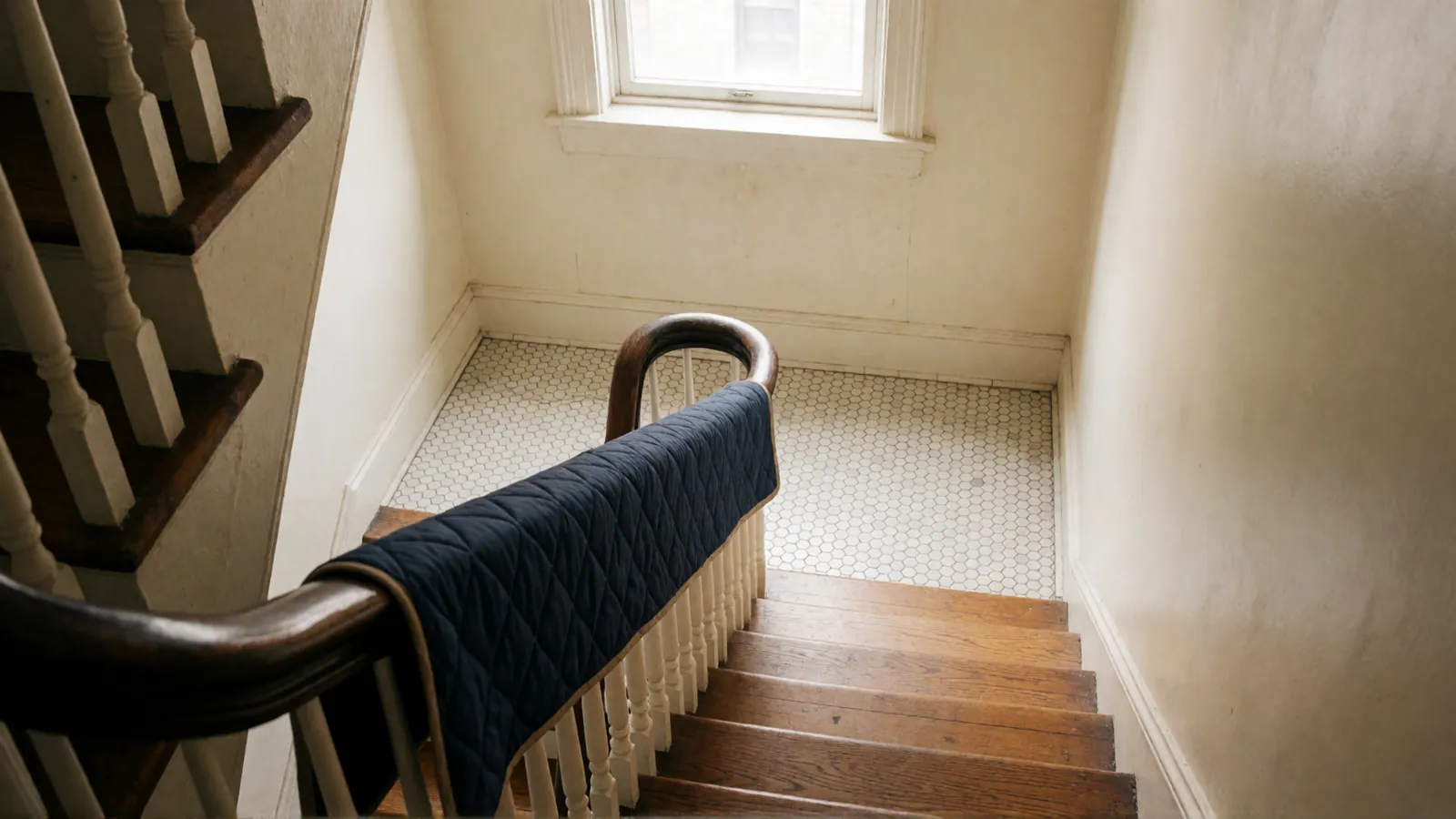
The apartment door is rarely the narrowest point. The narrowest point is the turn: the landing between two flights, where a long piece has to stop going down and start going round. A straight stair takes almost anything that fits through the door at the bottom. A prewar staircase that doubles back on itself, with the banister on the inside of the turn and a radiator on the landing, is a different question, and the answer depends on the length of the piece as much as its width.
Measure the stairs the way a crew reads them: the width between the wall and the banister, the depth of the landing, and the height from the landing to the underside of the flight above. Then measure the furniture against the tightest of those.
The sofa's diagonal
A sofa that won't go through a doorway lying flat usually goes through on its end. Stood up on one arm, it stops being a question of its length and becomes a question of its diagonal: measure from the top of the back to the front edge of the seat, on the slant. If that is less than the width of the opening, the sofa goes through on its end, and round the landing the same way, swung upright where the turn is tight.
Take the legs off first. Most unscrew by hand, and a sofa with its legs on is taller than it needs to be at exactly the moment it is being turned.
A sleeper sofa is the exception. The metal bed folded inside it makes it heavy and stiff, and it goes down the stairs flat, slowly, with hands at both ends. It is on the planner's list of heavy pieces (a treadmill or exercise bike, a large television, a marble or glass tabletop, a sleeper sofa, a big mirror or framed picture), because each of them takes its own time on a staircase.
The door, the banister and the hall
When a turn is too tight by a little, the apartment door comes off its hinges. The pins tap up and out, the door lifts away, and the opening gains the room the open door was taking. It goes back on before the crew leaves.
Bartholomew Nwosu-Strand leads the walk-up crews in Astoria, Sunnyside and Ridgewood. Bartholomew walks the stairs once before the first piece comes down. He wraps the banister before he wraps the furniture. The banister is wrapped first because it is what a mover reaches for on a turn, and what the corner of a dresser finds when the turn is tighter than it looked.
Runners on the floors and the hall, pads on the door frames, the banister wrapped on a walk-up, and the elevator padded where the building asks.
Why the fourth floor takes a third mover
From the fourth floor up, the crew grows by one.
On two or three flights, each mover can carry a piece from the apartment to the truck and climb back up for the next. From the fourth floor the crew splits the climb: one carries from the apartment to a landing, the next carries on to the street, and another keeps the truck loading. Nobody is still carrying a dresser down the whole staircase late in the afternoon, which is when pieces get dropped and backs get hurt. That is how a one-bedroom's crew of two becomes a crew of three, up to the largest crew of four.
No fee per flight: stairs take time, and the time is billed. The stairs at each end add time to that end's share of the work, more for each floor. Here is a third floor in one of the planner's worked examples:
A worked example: a planning range
One bedroom, third-floor walk-up to an elevator From Astoria to Woodside
One bedroom, about average · start: a third-floor walk-up · end: an elevator building · the kitchen and the breakables packed by us · a few pieces taken apart
- Crewfor this home and these stairsTwo movers
- Trucknamed by its length16-foot box truck
- Hours on the jobbilled in quarter hours5¼ to 7¾ hours
- Travel time, both waysone allowance each waythirty minutes
- Hourly rateevery day a move runs$150 an hour
- The time, at the ratethe hours and the travel; no sales tax$862.50 to $1,237.50
- Putting furniture back togetherits own line, at the same rate$112.50 to $150.00
- Sales tax on that line8.875%, New York City$9.98 to $13.31
- Boxes, counted on the daynot in the range: charged by the box25 to 40 boxes
- The rangea planning range, not an estimate$984.98 to $1,400.81
The move planner's answer to these questions, at the published rates. A planning range is not an estimate or a quote.
When a piece won't fit
Some pieces won't go down any staircase. The usual one is a box spring: a rigid frame that cannot bend round a landing the way a mattress can. A split box spring, two halves, is the answer at the new address. A sectional whose long side does not come apart, and a wardrobe built in the room, are the others.
That is a question for the survey, not for the landing on moving day:
When a piece fits neither the stairs nor the elevator, lifting it outside the building is rigging, and in New York City that is done by or under a licensed rigger. We don't do it. We tell you before moving day, you hire the rigger, and we carry the piece from the curb.
What to show us
On the survey call, start on the street, then walk up with the phone the way the furniture will come down, and stop on each landing. The rest of the list:
Before the survey
Open every closet and cabinet on the call, and the basement or the storage cage if you have one.
Show us the stairs from the street, the elevator and its door, and where a truck could stop.
Point out what is not coming: what you are selling, giving away or leaving behind.
Measure the widest sofa and the tallest wardrobe, and the narrowest door they must pass.
Have both addresses and both buildings' moving rules to hand, if you know them.
Plan your move
Try the move planner: a crew, a truck and a range of hours at the published rate, in about two minutes. Sending it to us books nothing.