The journal
Moving day and the curb in New York City
What the City allows a truck at the curb, why no mover can promise a space, and what a loading dock or a short walk does to the hours.
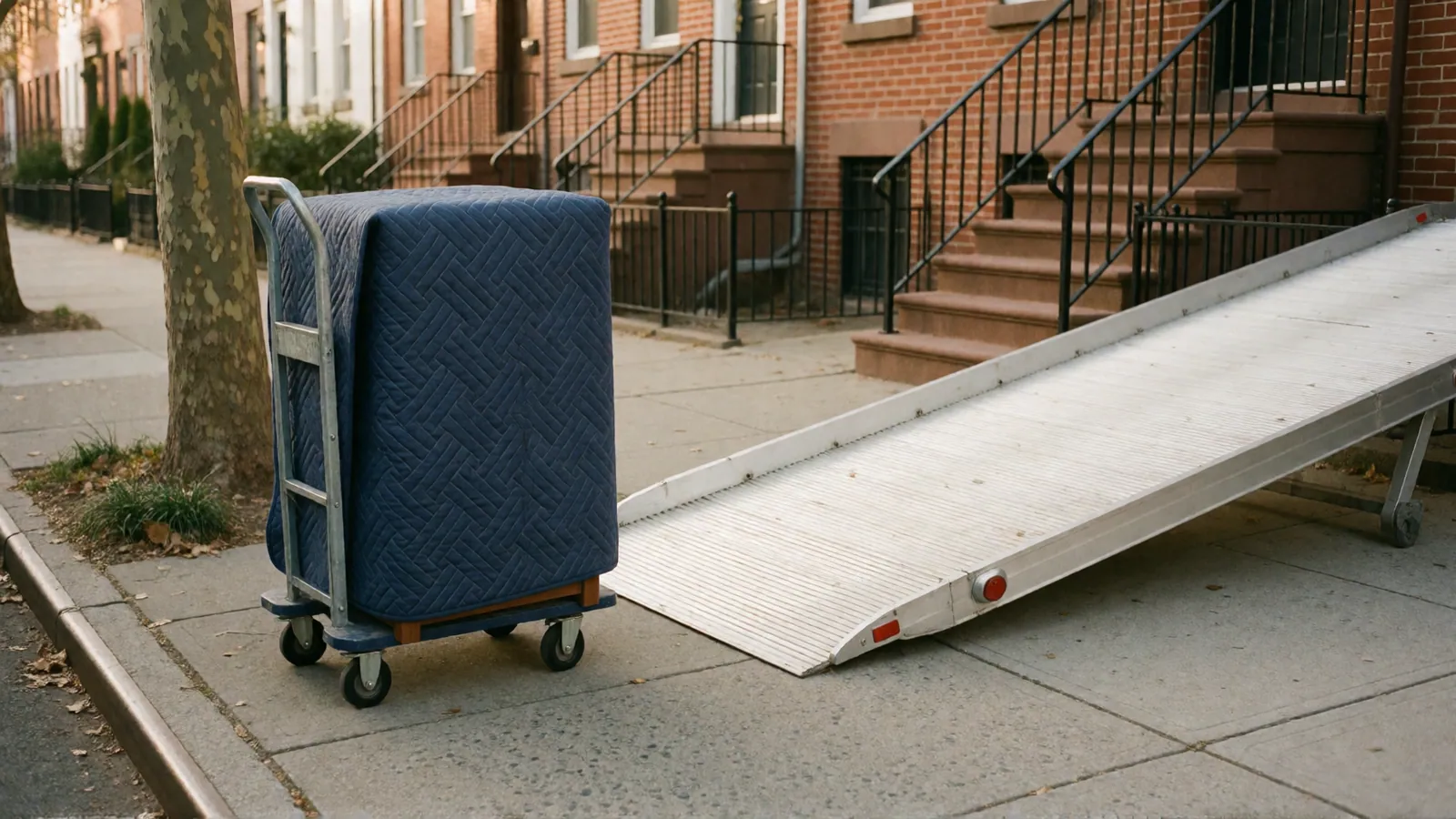
AI-generated illustration. Not a real home or business.
Every moving day in New York City starts with the same question, asked as the truck turns onto your block: where does it stop? The answer decides how far every piece is carried, at both ends, and so a part of the hours.
What the City allows
We can't reserve the curb. The City lets a truck double-park for twenty minutes at most, while loading, and only when the block has no free space or loading zone, so the crew takes the nearest legal space it can find. A parking ticket is never charged to you.
Twenty minutes is a useful rule and a short one. It is long enough to bring down the first heavy piece while the crew looks for a space, or to load the last few things at the end, and nowhere near long enough to load a home. For the hours in between, the truck needs a space at the curb like any other vehicle.
The rules, as they read in October 2026:
- 34 RCNY § 4-08 (opens the source in a new tab) A commercial vehicle may double-park for no more than twenty minutes while loading, and only when the block has no free space or loading zone on that side.
- NYSDOT sample tariff, Rule 15 (opens the source in a new tab) A parking fee is passed on only if it was disclosed in advance, and a parking ticket is never charged to the customer.
Why nobody can promise the curb
A space at the curb belongs to whoever reaches it first, legally. Cones, chairs, a trash can or a friend standing in the street are a long New York custom, and none of them is a reservation. A mover who promises the curb is promising something that is not its to give.
A car of your own is a different matter. If you have one parked near the door, leave it there until the truck arrives and move it then: the space it leaves is an ordinary legal space, and it is often the closest one on the block.
The walk from the truck to the door
The planner asks about it at both ends, in the same words: how far is the door from where a truck can stop? There are two answers:
- The truck can stop within about 75 feet of the door.
- Farther: a long path, a courtyard, a building at the back.
Stairs and a long walk take time, and the time is what you pay for; the move planner adds it to the hours. The walk is counted twice per piece, once out and once back empty-handed, so a building at the back of a courtyard or a house at the end of a long path adds time on every trip. In this worked example, the house in Nassau has a long walk at the new end:
A worked example: a planning range
A three-bedroom house to Nassau From Fresh Meadows to Nassau County
Three bedrooms, about average · start: a house with stairs inside · end: a house with stairs inside, a long walk to the truck · packed by you · several pieces taken apart · one or two heavy pieces
- Crewfor this home and these stairsFour movers
- Trucknamed by its length26-foot box truck
- Hours on the jobbilled in quarter hours7 to 10¼ hours
- Travel time, both waysone allowance each way1¼ hours
- Hourly rateevery day a move runs$260 an hour
- The time, at the ratethe hours and the travel; no sales tax$2,145.00 to $2,990.00
- Putting furniture back togetherits own line, at the same rate$195.00 to $260.00
- Sales tax on that line8.625%, Nassau County$16.82 to $22.43
- Boxes, counted on the daynot in the range: charged by the box60 to 95 boxes
- The rangea planning range, not an estimate$2,356.82 to $3,272.43
The move planner's answer to these questions, at the published rates. A planning range is not an estimate or a quote.
A loading dock, a courtyard, a service door
Many elevator buildings have a loading dock or a service entrance, and it is usually where a truck stands closest to the elevator. It is also the building's, with its own hours and its own booking, made through the same managing agent who books the service elevator. Ask about it at the same time, and ask whether a box truck fits under the entrance, because some were built for vans.
A garden apartment complex or a building set back behind a courtyard is the opposite case: the truck stops at the street and every piece walks. Say so in the planner's answer for that end, and show it on the survey call. The certificate and the elevator, booked together.
The streets a truck can take
The truck drives on the truck routes, which keep a truck off the parkways. A car takes the parkway; a box truck takes the expressway and the avenues. That is why the drive between your two addresses can take longer in the truck than it does in a car, and why the top of a planning range allows for the traffic on that drive.
What to tell us before the day
On the survey call, show us the stairs from the street, the elevator and its door, and where a truck could stop. And tell us about any of these:
- A hydrant, a bus stop, a bike lane or a driveway right outside the door.
- A one-way street, or a block that is closed off on certain days.
- A loading dock or a service entrance, and its hours.
- The way into the building from the street: a stoop, a gate, steps down to a basement door.
Plan your move
Try the move planner: a crew, a truck and a range of hours at the published rate, in about two minutes. Sending it to us books nothing.