Moves
The move planner
Your answers in; a crew, a truck and a range of hours out, at the published rate, with every charge listed before you send anything.
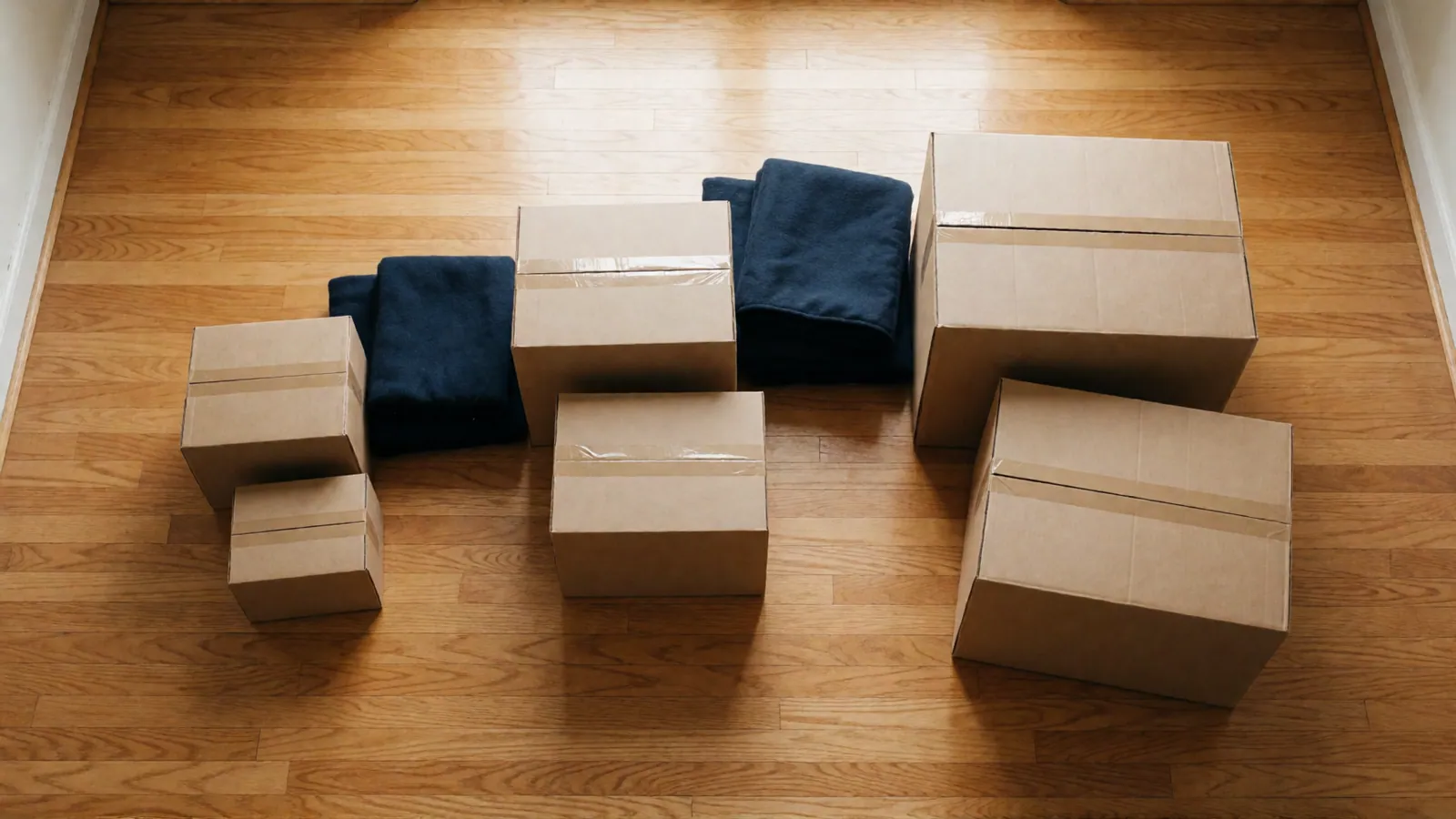
AI-generated illustration. Not a real home or business.
How to answer it
The planner asks what a surveyor would, in roughly the order a surveyor walks a home. These are its questions, with the line of help printed under each.
What are you moving?
Count the bedrooms, not the rooms.
How full is it?
Think of the closets and the storage, not only the furniture.
Where does the move start?
"Woodside and next door" means Woodside, Sunnyside, Jackson Heights, East Elmhurst, Astoria, Long Island City, Elmhurst, Maspeth, Ridgewood, Middle Village, Rego Park, Forest Hills and Corona.
And where does it end?
One end of every move is in Queens.
At the start: how do we get to the door?
Count the flights from the street.
At the end: how do we get to the door?
Count the flights from the street.
Who packs?
We wrap the furniture whatever you choose.
Heavy or awkward pieces?
A treadmill or exercise bike, a large television, a marble or glass tabletop, a sleeper sofa, a big mirror or framed picture.
When an answer sits between two choices, take the bigger one. A range made from a generous answer is easier to plan around than one that runs over on the day, and the survey will bring it back down if the home is lighter than you thought.
What the planner cannot know
Six things a range made from answers cannot do.
- It reads your answers. It has not seen your home, your stairs or your furniture, and a range made from answers is a guess said honestly.
- It never prints one total. A move is charged by the time it takes, so the result is a range, and both ends are as likely as each other.
- It does not price a grand piano, a single piece of 1,000 pounds or more, or anything that would have to go out of a window. Those are surveyed.
- It does not price an office. An office is surveyed first.
- It counts boxes, not the price of boxes. Boxes are charged by the box, at the price list, for the boxes used.
- It is not an estimate in law, and sending it books nothing.
A worked example
What a result looks like
Each result lists the crew, the truck, the hours on the job, the travel time, the rate and the time at the rate; then the lines that carry their own tax; then the range itself, both ends the same size.
Under it, every charge a move can carry is listed before anything can be sent, and sending it is a choice, not a step you have to take.
A worked example: a planning range
One bedroom, third-floor walk-up to an elevator From Astoria to Woodside
One bedroom, about average · start: a third-floor walk-up · end: an elevator building · the kitchen and the breakables packed by us · a few pieces taken apart
- Crewfor this home and these stairsTwo movers
- Trucknamed by its length16-foot box truck
- Hours on the jobbilled in quarter hours5¼ to 7¾ hours
- Travel time, both waysone allowance each waythirty minutes
- Hourly rateevery day a move runs$150 an hour
- The time, at the ratethe hours and the travel; no sales tax$862.50 to $1,237.50
- Putting furniture back togetherits own line, at the same rate$112.50 to $150.00
- Sales tax on that line8.875%, New York City$9.98 to $13.31
- Boxes, counted on the daynot in the range: charged by the box25 to 40 boxes
- The rangea planning range, not an estimate$984.98 to $1,400.81
The move planner's answer to these questions, at the published rates. A planning range is not an estimate or a quote.
When the range looks right
The next step is the survey: a video call through the rooms, or a visit to your home.